|
apoCHARMM 1.0.0
High-performance molecular dynamics simulations on GPUs
|

|
|
apoCHARMM 1.0.0
High-performance molecular dynamics simulations on GPUs
|
|
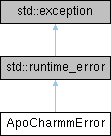
Represents a categorized native error with source metadata. More...
#include <ApoCharmmError.h>
Public Member Functions | |
| ApoCharmmError (const ApoCharmmErrorCode code, const std::string_view message, const std::string_view sourceFile, const std::string_view sourceFunction, const int sourceLine) | |
| Constructs a categorized exception and renders its diagnostic. | |
| ApoCharmmErrorCode | getCode (void) const noexcept |
| Returns the retained failure category. | |
| std::string_view | getMessage (void) const noexcept |
| Returns the retained human-readable message. | |
| std::string_view | getSourceFile (void) const noexcept |
| Returns the normalized source-file spelling. | |
| std::string_view | getSourceFunction (void) const noexcept |
| Returns the retained source-function spelling. | |
| int | getSourceLine (void) const noexcept |
| Returns the retained source-line value. | |
Represents a categorized native error with source metadata.
The exception owns copies of its human message, normalized source-file spelling, source function, and source line. The inherited what() diagnostic begins with the apoCHARMM ASCII banner and then reports the category, message, source location, and function. The exception remains catchable as std::runtime_error and std::exception.
Views returned by the string accessors borrow storage from this object. Copying the exception creates an independent logical copy of that metadata. Moving transfers the metadata, and may invalidate views into the moved-from exception.
| ApoCharmmError::ApoCharmmError | ( | const ApoCharmmErrorCode | code, |
| const std::string_view | message, | ||
| const std::string_view | sourceFile, | ||
| const std::string_view | sourceFunction, | ||
| const int | sourceLine | ||
| ) |
Constructs a categorized exception and renders its diagnostic.
All character data is copied before the constructor returns. A source path beneath the configured apoCHARMM source root is stored relative to that root. Any other path containing / or \ is reduced to its final path component.
| [in] | code | Failure category to retain. |
| [in] | message | Human-readable diagnostic. The text may be empty or multiline and is copied without normalization. |
| [in] | sourceFile | Source-file spelling to normalize and copy. |
| [in] | sourceFunction | Source-function spelling to copy unchanged. |
| [in] | sourceLine | Source-line value to store unchanged. |
| std::bad_alloc | If owned diagnostic storage cannot be allocated. |
| std::length_error | If an input or rendered diagnostic exceeds an implementation-defined string limit. |
|
noexcept |
Returns the retained failure category.
|
noexcept |
Returns the retained human-readable message.
|
noexcept |
Returns the normalized source-file spelling.
|
noexcept |
Returns the retained source-function spelling.
|
noexcept |
Returns the retained source-line value.
__LINE__ value.  1.9.8
1.9.8